trend research - the future 100
- Feb 21, 2019
- 3 min read
Updated: Mar 6, 2019





Full report here :
Sociology
There is a problem with fairness of people, brands and influencers. It is considered by average consumers and also by brands that a lot of people are shady and have dishonest business models.
This also leads to the cancelled culture very common amongst social media, where people cancel influencers or brands based on a thing they said or did once. This also relates to people needing to create their own unfiltered image. Celebrities do this and that is actually killing tabloids. If brands did this it could be a potential end to cancelled culture and rise of a more honest consumerism, and could potentially ease the whole anarchist movement.
Playfulness and friendliness of technology is put forward as we humanise bots. It’s like we’re transferring our humanity to them. It’s possible to think that bots will make us more human. How can we incorporate that in fashion technology? Can fashion bots teach us to be human?
We need to start engaging people to be less passive in life, not just on social media, this way the more people are engaged the more we can find solutions to problems together. Although there is a lot of activism, the majority stays passive out of fear of failing or fear of not being recognised.
Ethical digitalisation and digitalisation of everything: digitality has opened a whole new world of possibilities for everyone and everything, it is important to explore it, and many fashion brands do it. However it is important to consider humans are using it and it must stay ethical. Just because we are hidden behind a black glass window, doesn’t man we don’t affect people.
Brands and governments are typically the most hated entities in the world today. One way for brand to make a new spot for themselves and be more well viewed today, is to go with the consumer and not against. Listen to them and encourage them. Brands need to start getting a bit political, to replace politicians who haven’t done their part according to the population.
Inclusivity
Everybody is different and everybody feels different, the world is very bipolar today, where people have to fit into one thing or the other, and it’s not working anymore. Its toxic and distressing, brands have to start being the callers, the mediators of all of these ideas and individualities, by listening in to their consumer
Although some like to preach that the world is inclusive today and we don’t need Social justice or feminism, it is not the case. Thing is, we have artificial intelligence coming in, and we have to teach them to be unbiased, brands can take a step forward to including everyone, so AI doesn’t get “confused”.
The first backlash to the new need for perfection was natural beauty, which worked in a way but not completely, some people decided to start ridiculing the way bodies were altered, and created alien bodies: think of Matières Fécales” collective.
Another way people have decided to “fight beauty standards” is by creating a new one, a digital one, probably also to portray how unreal and natural the human body standards are today.
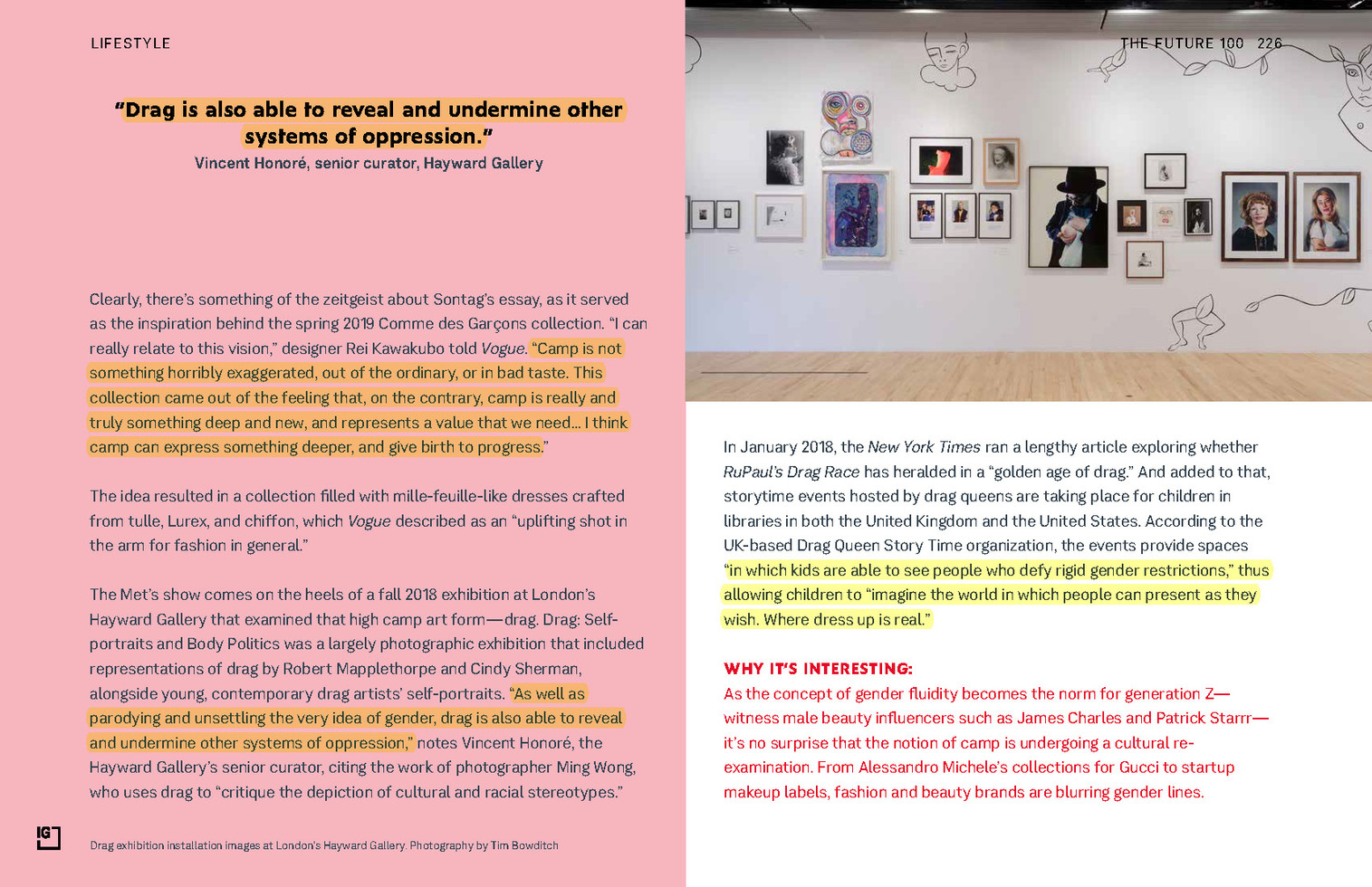
Camp and drag have now become a predominant part of pop culture, appealing to non lgbt audiences as well. This is very good news for gender revolution and gender bending, as it is not as negatively seen. It is still widely accepted as performance art, and not necessarily accepted as a way of life however.
Political correctness
People expect brands to know what they are talking about and know what they are doing, and not make any faux pas, in fact they even expect them to call out others on their failures to follow a politically correct agenda.
People are starting to be done with code culture and breaking the stigmas and the norms by shedding the light and normalising taboos
conclusion | there is a shift in the way we will look, what will be humanity? how will be human? people are already exploring possibilities as a way to fight stigmas and engage in the rise of body modification. creating an alien self. there is still much stigma to be removed especially in regards to gender expression
the need for transparency has become more and more needed and people are now relying on themselves and activism for change. brands have no excuse anymore, and they are expected to have a political stance.
Greene, L. (2019). The Future 100: 2019 [Ebook] (1st ed., pp. 16-18,32-37,40-41,54,55,78,86,87,122-126,176,177,222-226). J W Thompson Intelligence. Retrieved from https://www.jwtintelligence.com/trend-reports/the-future-100-2019/
Comments